Rootd
A hyperlocal community app connecting neighbors through shared events, skill-swaps, and mutual aid.
01 / The Opportunity
68% of urban residents don't know their neighbors' names
That statistic stopped me in my tracks. We live closer to more people than ever before, yet loneliness and disconnection keep climbing. The platforms that claim to serve neighborhoods, like Nextdoor and Facebook Groups, have become dumping grounds for complaints, political arguments, and ads. The signal-to-noise ratio makes it nearly impossible to find genuine human connection.
There's a gap between "social media for your street" and actual community building. People want to know who lives nearby, share skills, attend local events, and help each other out. But the existing tools make that feel transactional or risky rather than natural and warm. Rootd was designed to fill that gap: a space for genuine neighbor-to-neighbor connection, free of ads and algorithmic noise.
The landscape
- Nextdoor: dominated by complaints and lost pet posts
- Facebook Groups: algorithm-driven, ad-heavy, low trust
- WhatsApp groups: chaotic, no structure, hard to discover
- Nothing designed specifically for positive community action
The opportunity
- People crave local connection but lack a good tool
- Events, skill-sharing, and mutual aid are underserved
- Trust and safety are non-negotiable for neighborhood apps
- Map-based discovery feels more natural than endless feeds
02 / User Research
Walking the neighborhoods, hearing the stories
I conducted 15 in-depth interviews across four Toronto neighborhoods: Leslieville, Kensington Market, The Junction, and Liberty Village. Each neighborhood had a different character, density, and demographic mix, which was intentional. I wanted to understand how community needs differed based on context, not just find a single universal pattern.
The interviews surfaced a consistent theme: people wanted connection but felt awkward initiating it. One participant in Kensington said, "I've lived here for three years and I wave at the same people every morning, but I have no idea who they are." Another in Liberty Village described organizing a building potluck through paper flyers because no digital tool felt appropriate.
I supplemented the interviews with a 50-person survey distributed through local community boards and social channels. The quantitative data confirmed the qualitative findings and helped me triangulate priorities. From all of this, I synthesized three core personas that guided every design decision going forward.
- 15 in-depth interviews across 4 Toronto neighborhoods (Leslieville, Kensington Market, The Junction, Liberty Village)
- 50-person survey distributed through community boards and local social channels
- 3 personas synthesized: The Connector (organizes events, knows everyone), The Newcomer (recently moved, wants to meet people), and The Helper (prefers one-on-one acts of service over group events)
- Affinity mapping revealed 4 core needs: event discovery, skill exchange, neighborhood updates, and trust/safety mechanisms
Key research insight
"The biggest barrier to community isn't willingness. It's the first move. People want to connect but don't know how to start without it feeling forced."
03 / Ideation & Concept
From 12 ideas to 3 core flows
I ran a Crazy 8s workshop with the product team, generating a wide range of feature concepts in rapid-fire rounds. We then used dot voting to narrow 12 initial ideas down to the features that mapped most directly to our persona needs. The three that emerged as clear priorities became the app's core experience.
The first was Events: a simple way to discover and RSVP to things happening nearby, from block parties to book clubs to weekend cleanups. The second was Skill Swap: a structured way to offer and request help, whether that's teaching someone to cook, fixing a bike, or walking a dog. The third was the Community Feed: a low-noise stream of neighborhood updates, welcomes, and local news.
What we intentionally left out was just as important as what we included. There would be no marketplace, no advertising, no algorithmic feed ranking, and no anonymous posting. Every decision was filtered through one question: does this build trust between neighbors?
Core flows
- Events: discover, create, and RSVP to neighborhood happenings
- Skill Swap: offer skills or request help from nearby neighbors
- Community Feed: neighborhood updates without algorithmic noise
Intentional exclusions
- No marketplace or buy/sell features
- No advertising or sponsored content
- No algorithmic feed ranking
- No anonymous posting
04 / Wireframes & Testing
Paper to pixels, assumptions to evidence
I started with paper prototypes to keep things fast and disposable. The first round of testing with 8 participants focused on the three core flows, and the feedback reshaped the app's navigation model entirely. My original assumption was that users would want a feed-first experience, similar to most social apps. I was wrong.
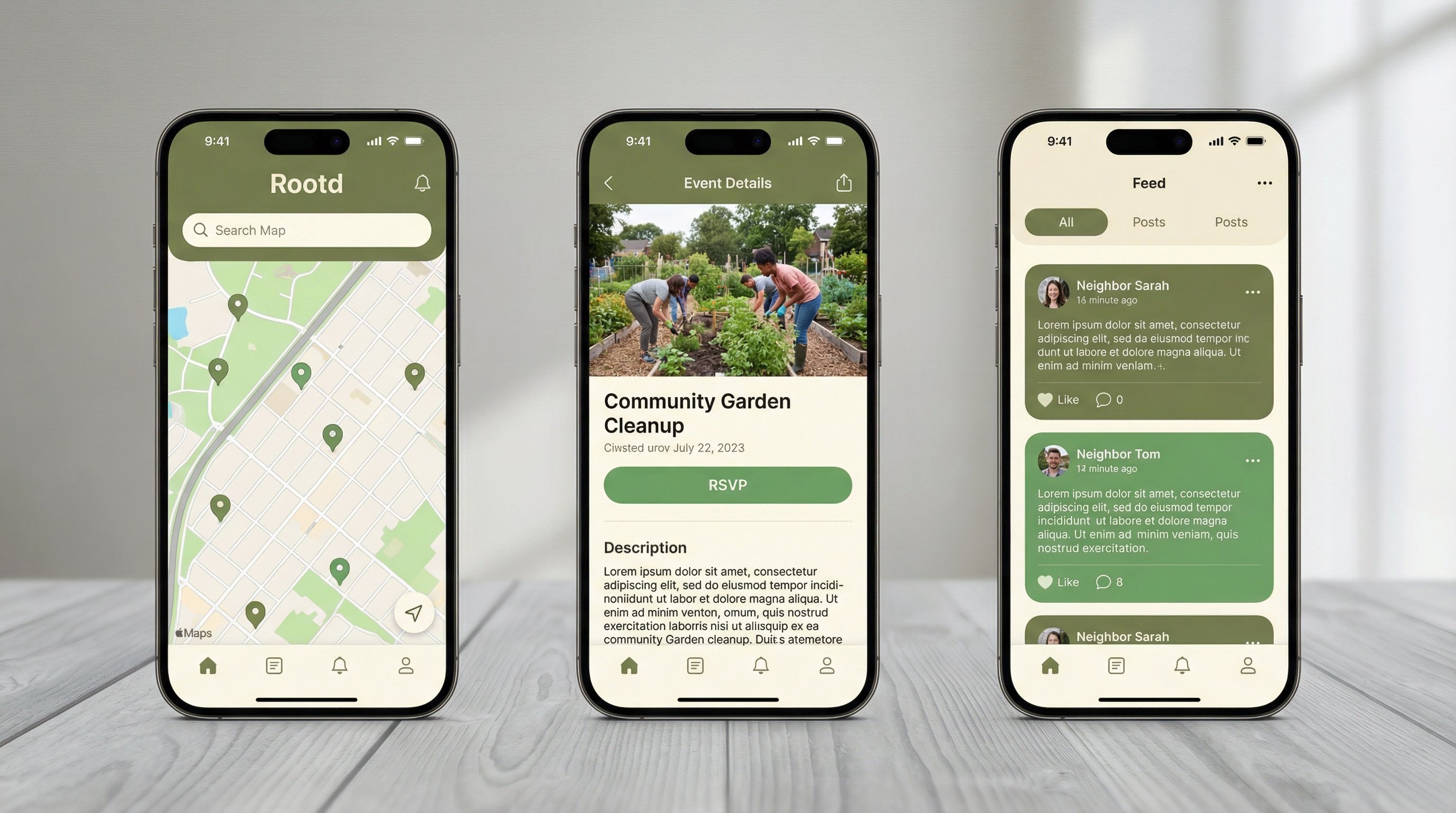
Participants consistently gravitated toward the map view. They wanted to see what was happening around them spatially, not scroll through a timeline. One tester said, "Show me what's near me. I don't care what happened yesterday three blocks away." This insight shifted Rootd from a feed-first to a map-first experience, with the community feed becoming a secondary tab rather than the home screen.
I iterated to mid-fidelity wireframes in Figma and ran a second round of testing with 6 new participants. This round validated the map-first approach and surfaced smaller usability issues: the skill swap request flow had too many steps, the event creation form needed a "quick post" option for informal gatherings, and the onboarding flow needed to explain the map permissions more clearly.
- Paper prototypes tested with 8 participants across all 3 core flows
- Key pivot: feed-first to map-first based on consistent user preference
- Mid-fi Figma wireframes tested with 6 new participants
- Skill swap flow simplified from 7 steps to 4
- Event creation split into "full event" and "quick gathering" paths
- Onboarding redesigned to explain map permissions with clear value proposition
Pivotal moment
"Show me what's near me. I don't care what happened yesterday three blocks away." This single piece of feedback from testing fundamentally changed the app's navigation model.
05 / Visual Design
Warm, approachable, and nothing like a tech company
The visual identity needed to feel like a neighbor, not a corporation. I chose a warm palette anchored by sage green, cream, and soft terracotta. These colors evoke earth, warmth, and organic growth, which aligned perfectly with the app's mission. The palette intentionally avoided the cold blues and stark whites that dominate most tech products.
Typography and illustration played equally important roles. I selected a friendly rounded sans-serif for headings and a highly legible body font optimized for mobile reading. For empty states and onboarding, I created custom illustrations with a hand-drawn quality, showing neighbors gardening together, sharing meals, and chatting on stoops. These illustrations set the emotional tone and made the app feel alive even before users had content to fill it.
Accessibility was non-negotiable. Every color combination met AA contrast requirements. All touch targets were at least 44px. I tested the full prototype with VoiceOver and TalkBack to ensure screen reader compatibility. The map view included a list-based alternative for users who preferred or needed a non-visual navigation method.
Visual direction
- Warm palette: sage green, cream, soft terracotta
- Rounded sans-serif headings for approachability
- Custom hand-drawn illustrations for empty states
- Organic shapes and soft shadows, no hard edges
Accessibility
- AA contrast on all color combinations
- 44px minimum touch targets throughout
- VoiceOver and TalkBack tested
- List-based alternative to map navigation
06 / Launch & Results
1,200 sign-ups from a single neighborhood
Rootd launched as a pilot in Leslieville, Toronto, a neighborhood with a strong existing sense of community identity. We chose Leslieville deliberately: it had enough density and social infrastructure to give the app the best chance of reaching critical mass quickly. The results exceeded every projection we had.
Within the first two weeks, 1,200 residents had signed up. The weekly active rate settled at 73%, which was remarkable for a brand-new social product. Neighbors were creating an average of 2.3 events per week per neighborhood cluster, ranging from weekend yoga sessions in the park to tool-lending circles and language exchange meetups. The skill swap feature saw steady organic growth as people realized they could trade piano lessons for help assembling furniture.
The press picked it up too. BlogTO featured Rootd in a piece about Toronto apps making city life feel more human. But the metric that meant the most to me wasn't in any dashboard. It was the beta tester who told us, "I finally know the name of the couple next door, and it only took downloading an app."
Launch metrics
- 1,200 sign-ups in the Leslieville pilot
- 73% weekly active rate
- 2.3 events created per week per neighborhood
- Featured in BlogTO
What resonated
- Map-first navigation praised as "intuitive" by 89% of surveyed users
- Skill swap was the most-shared feature on social media
- "Quick gathering" events used 3x more than formal event creation
- Zero reports of harassment or spam in first month
User feedback
"I finally know the name of the couple next door, and it only took downloading an app." - Beta tester, Leslieville